Number of Families Who Own Pcs Between 1990 and 2000
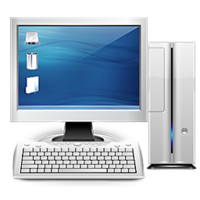
An creative person's depiction of a 2000s-era desktop-style personal reckoner, which includes a metallic case with the computing components, a brandish monitor and a keyboard (mouse not shown)
A personal computer (PC) is a multi-purpose microcomputer whose size, capabilities, and cost brand information technology feasible for individual use.[1] Personal computers are intended to be operated direct by an end user, rather than by a computer expert or technician. Unlike large, costly minicomputers and mainframes, time-sharing by many people at the aforementioned time is not used with personal computers. Primarily in the late 1970s and 1980s, the term abode computer was as well used.
Institutional or corporate computer owners in the 1960s had to write their own programs to do any useful work with the machines. While personal reckoner users may develop their own applications, usually these systems run commercial software, gratuitous-of-charge software ("freeware"), which is most oft proprietary, or free and open up-source software, which is provided in "ready-to-run", or binary, form. Software for personal computers is typically developed and distributed independently from the hardware or operating arrangement manufacturers.[ii] Many personal computer users no longer demand to write their own programs to make whatsoever use of a personal figurer, although end-user programming is however feasible. This contrasts with mobile systems, where software is often bachelor only through a manufacturer-supported channel,[three] and finish-user program evolution may exist discouraged by lack of support past the manufacturer.[4]
Since the early 1990s, Microsoft operating systems and Intel hardware dominated much of the personal computer marketplace, outset with MS-DOS and then with Microsoft Windows. Alternatives to Microsoft's Windows operating systems occupy a minority share of the manufacture. These include Apple'southward macOS and gratuitous and open up-source Unix-similar operating systems, such as Linux.
The appearance of personal computers and the concurrent Digital Revolution have significantly affected the lives of people in all countries.
Terminology [edit]
The term "PC" is an initialism for "personal computer". While the IBM Personal Estimator incorporated the designation in its model proper noun, the term originally described personal computers of any make.
In some contexts, "PC" is used to contrast with "Mac", an Apple tree Macintosh figurer.[5] [6] [7] [8] Since none of these Apple tree products were mainframes or time-sharing systems, they were all "personal computers" and not "PC" (make) computers.
In 1995, a CBS segment on the growing popularity of PC reported "For many newcomers PC stands for Pain and Confusion".[nine]
History [edit]


The "encephalon" [computer] may one day come up down to our level [of the common people] and aid with our income-tax and volume-keeping calculations. Just this is speculation and there is no sign of it so far.
—British paper The Star in a June 1949 news article about the EDSAC estimator, long before the era of the personal computers.[10]
In the history of computing, early experimental machines could exist operated by a unmarried attendant. For case, ENIAC which became operational in 1946 could exist run by a single, albeit highly trained, person.[11] This way pre-dated the batch programming, or time-sharing modes with multiple users continued through terminals to mainframe computers. Computers intended for laboratory, instrumentation, or engineering science purposes were built, and could exist operated by one person in an interactive way. Examples include such systems as the Bendix G15 and LGP-xxx of 1956, and the Soviet MIR serial of computers developed from 1965 to 1969.[ commendation needed ] By the early 1970s, people in academic or enquiry institutions had the opportunity for single-person apply of a computer organization in interactive mode for extended durations, although these systems would still have been too expensive to be endemic by a single person.
The personal computer was made possible by major advances in semiconductor technology. In 1959, the silicon integrated circuit (IC) chip was developed by Robert Noyce at Fairchild Semiconductor,[12] and the metal-oxide-semiconductor (MOS) transistor was adult by Mohamed Atalla and Dawon Kahng at Bell Labs.[13] The MOS integrated excursion was commercialized by RCA in 1964,[14] and then the silicon-gate MOS integrated circuit was developed by Federico Faggin at Fairchild in 1968.[15] Faggin later used silicon-gate MOS technology to develop the first single-chip microprocessor, the Intel 4004, in 1971.[sixteen] The first microcomputers, based on microprocessors, were developed during the early 1970s. Widespread commercial availability of microprocessors, from the mid-1970s onwards, made computers cheap plenty for modest businesses and individuals to own.
In what was later to be chosen the Female parent of All Demos, SRI researcher Douglas Engelbart in 1968 gave a preview of features that would subsequently become staples of personal computers: electronic mail, hypertext, discussion processing, video conferencing, and the mouse. The demonstration required technical back up staff and a mainframe time-sharing computer that were far as well plush for individual business use at the time.
Early personal computers—generally called microcomputers—were frequently sold in a kit form and in limited volumes, and were of involvement mostly to hobbyists and technicians. Minimal programming was done with toggle switches to enter instructions, and output was provided by front end panel lamps. Applied use required adding peripherals such as keyboards, computer displays, disk drives, and printers.
Micral N was the earliest commercial, non-kit microcomputer based on a microprocessor, the Intel 8008. It was congenital starting in 1972, and a few hundred units were sold. This had been preceded by the Datapoint 2200 in 1970, for which the Intel 8008 had been commissioned, though not accustomed for use. The CPU pattern implemented in the Datapoint 2200 became the basis for x86 architecture[17] used in the original IBM PC and its descendants.[eighteen]
In 1973, the IBM Los Gatos Scientific Center developed a portable computer prototype called SCAMP (Special Computer APL Machine Portable) based on the IBM PALM processor with a Philips compact cassette drive, minor CRT, and full function keyboard. SCAMP emulated an IBM 1130 minicomputer in order to run APL/1130.[19] In 1973, APL was by and large available only on mainframe computers, and most desktop sized microcomputers such as the Wang 2200 or HP 9800 offered only Bones. Because SCAMP was the beginning to emulate APL/1130 performance on a portable, single user reckoner, PC Magazine in 1983 designated SCAMP a "revolutionary concept" and "the earth'southward first personal computer".[19] [20] This seminal, single user portable computer at present resides in the Smithsonian Institution, Washington, D.C.. Successful demonstrations of the 1973 SCAMP prototype led to the IBM 5100 portable microcomputer launched in 1975 with the power to be programmed in both APL and Basic for engineers, analysts, statisticians, and other business problem-solvers. In the late 1960s such a machine would have been most as large every bit ii desks and would have weighed virtually half a ton.[19]
Another desktop portable APL machine, the MCM/lxx, was demonstrated in 1973 and shipped in 1974. It used the Intel 8008 processor.
A seminal step in personal computing was the 1973 Xerox Alto, adult at Xerox's Palo Alto Research Center (PARC). It had a graphical user interface (GUI) which later served as inspiration for Apple'due south Macintosh, and Microsoft's Windows operating system. The Alto was a sit-in project, not commercialized, as the parts were likewise expensive to be affordable.[21]
Also in 1973 Hewlett Packard introduced fully Basic programmable microcomputers that fit entirely on summit of a desk, including a keyboard, a pocket-sized one-line display, and printer. The Wang 2200 microcomputer of 1973 had a full-size cathode ray tube (CRT) and cassette tape storage.[22] These were by and large expensive specialized computers sold for business organization or scientific uses.
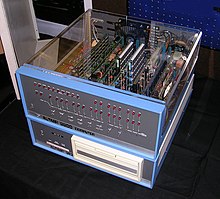
1974 saw the introduction of what is considered by many to be the first true "personal computer", the Altair 8800 created by Micro Instrumentation and Telemetry Systems (MITS).[23] [24] Based on the eight-fleck Intel 8080 Microprocessor,[25] the Altair is widely recognized every bit the spark that ignited the microcomputer revolution[26] as the kickoff commercially successful personal computer.[27] The reckoner charabanc designed for the Altair was to become a de facto standard in the form of the S-100 double-decker, and the first programming linguistic communication for the machine was Microsoft'south founding production, Altair BASIC.[28] [29]
In 1976, Steve Jobs and Steve Wozniak sold the Apple I computer circuit lath, which was fully prepared and independent most 30 chips. The Apple I computer differed from the other kit-style hobby computers of era. At the request of Paul Terrell, owner of the Byte Shop, Jobs and Wozniak were given their first purchase order, for 50 Apple tree I computers, only if the computers were assembled and tested and not a kit computer. Terrell wanted to accept computers to sell to a wide range of users, non just experienced electronics hobbyists who had the soldering skills to assemble a computer kit. The Apple I as delivered was all the same technically a kit computer, as it did not have a ability supply, example, or keyboard when it was delivered to the Byte Shop.
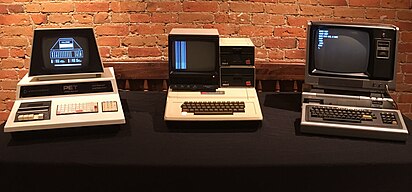
The iii personal computers referred to past Byte Magazine as the "1977 Trinity" of home computing: The Commodore PET, the Apple Two, and the TRS-fourscore Model I.
The first successfully mass-marketed personal computer to be announced was the Commodore PET subsequently existence revealed in January 1977. However, it was back-ordered and non bachelor until after that year.[30] Three months later (April), the Apple tree Two (unremarkably referred to as the "Apple") was announced with the first units being shipped ten June 1977,[31] and the TRS-fourscore from Tandy Corporation / Tandy Radio Shack following in Baronial 1977, which sold over 100,000 units during its lifetime. Together, these iii machines were referred to every bit the "1977 trinity". Mass-market, ready-assembled computers had arrived, and immune a wider range of people to apply computers, focusing more on software applications and less on development of the processor hardware.
In 1977 the Heath company introduced personal reckoner kits known as Heathkits, starting with the Heathkit H8, followed by the Heathkit H89 in belatedly 1979. With the purchase of the Heathkit H8 yous would obtain the chassis and CPU menu to assemble yourself, additional hardware such equally the H8-one memory lath that contained 4k of RAM could also be purchased in order to run software. The Heathkit H11 model was released in 1978 and was i of the first xvi-bit personal computers; nonetheless, due to its loftier retail toll of $1,295 was discontinued in 1982.[32] [33] [34]
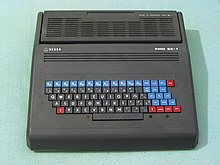
During the early 1980s, home computers were further developed for household use, with software for personal productivity, programming and games. They typically could exist used with a television receiver already in the home every bit the figurer display, with depression-detail blocky graphics and a limited colour range, and text about 40 characters broad by 25 characters alpine. Sinclair Research,[35] a UK company, produced the ZX Series—the ZX80 (1980), ZX81 (1981), and the ZX Spectrum; the latter was introduced in 1982, and totaled viii million unit sold. Post-obit came the Commodore 64, totaled 17 million units sold [36] [37] and the Amstrad CPC serial (464–6128).
In the same year, the NEC PC-98 was introduced, which was a very popular personal calculator that sold in more than 18 million units.[38] Another famous personal figurer, the revolutionary Amiga 1000, was unveiled by Commodore on 23 July 1985. The Amiga 1000 featured a multitasking, windowing operating organisation, colour graphics with a 4096-color palette, stereo sound, Motorola 68000 CPU, 256 KB RAM, and 880 KB three.five-inch deejay drive, for U.s.a.$1,295.[39]
Somewhat larger and more expensive systems were aimed at part and pocket-sized business organisation use. These often featured 80-column text displays but might non have had graphics or audio capabilities. These microprocessor-based systems were nevertheless less plush than fourth dimension-shared mainframes or minicomputers.
Workstations were characterized past loftier-operation processors and graphics displays, with large-capacity local disk storage, networking capability, and running under a multitasking operating organisation. Eventually, due to the influence of the IBM PC on the personal figurer marketplace, personal computers and home computers lost whatever technical distinction. Business concern computers acquired color graphics capability and sound, and abode computers and game systems users used the same processors and operating systems as function workers. Mass-market place computers had graphics capabilities and memory comparable to defended workstations of a few years before. Even local area networking, originally a manner to permit business computers to share expensive mass storage and peripherals, became a standard feature of personal computers used at abode.
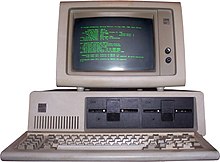
IBM'south first PC was introduced on 12 Baronial 1981.[40]
In 1982 "The Computer" was named Machine of the Yr past Fourth dimension magazine. In the 2010s, several companies such equally Hewlett-Packard and Sony sold off their PC and laptop divisions. As a outcome, the personal computer was alleged expressionless several times during this period.[41]
An increasingly important set up of uses for personal computers relied on the power of the computer to communicate with other computer systems, allowing interchange of data. Experimental public access to a shared mainframe computer system was demonstrated as early as 1973 in the Community Memory project, but bulletin board systems and online service providers became more normally available after 1978. Commercial Net service providers emerged in the late 1980s, giving public admission to the rapidly growing network.
In 1991, the Www was fabricated available for public use. The combination of powerful personal computers with loftier-resolution graphics and audio, with the infrastructure provided by the Internet, and the standardization of admission methods of the Web browsers, established the foundation for a significant fraction of modern life, from bus time tables through unlimited distribution of free videos through to online user-edited encyclopedias.
Types [edit]
Stationary [edit]
Workstation [edit]

A workstation is a high-end personal computer designed for technical, mathematical, or scientific applications. Intended primarily to be used past one person at a time, they are normally connected to a local area network and run multi-user operating systems. Workstations are used for tasks such every bit computer-aided blueprint, drafting and modeling, computation-intensive scientific and engineering calculations, image processing, architectural modeling, and estimator graphics for animation and motility film visual effects.[42]
Desktop computer [edit]

Before the widespread use of PCs, a computer that could fit on a desk was remarkably modest, leading to the "desktop" nomenclature. More recently, the phrase usually indicates a detail way of calculator case. Desktop computers come in a variety of styles ranging from large vertical tower cases to small models which can exist tucked behind or remainder directly below (and support) LCD monitors.
While the term "desktop" oft refers to a reckoner with a vertically aligned reckoner tower case, these varieties frequently rest on the ground or underneath desks. Despite this seeming contradiction, the term "desktop" does typically refer to these vertical tower cases besides as the horizontally aligned models which are designed to literally rest on tiptop of desks and are therefore more than advisable to the "desktop" term, although both types qualify for this "desktop" characterization in most practical situations aside from certain physical organization differences. Both styles of these estimator cases hold the systems hardware components such as the motherboard, processor scrap, other internal operating parts. Desktop computers accept an external monitor with a display screen and an external keyboard, which are plugged into ports on the back of the figurer case. Desktop computers are popular for home and business calculating applications as they leave infinite on the desk for multiple monitors.
A gaming computer is a desktop estimator that more often than not comprises a high-performance video card, processor and RAM, to ameliorate the speed and responsiveness of demanding video games.[43]
An all-in-one computer (also known as single-unit PCs) is a desktop computer that combines the monitor and processor inside a single unit. A separate keyboard and mouse are standard input devices, with some monitors including touchscreen capability. The processor and other working components are typically reduced in size relative to standard desktops, located behind the monitor, and configured similarly to laptops.
A nettop computer was introduced by Intel in February 2008, characterized past low cost and lean functionality. These were intended to be used with an Internet connexion to run Spider web browsers and Internet applications.
A Home theater PC (HTPC) combines the functions of a personal calculator and a digital video recorder. Information technology is continued to a Tv or an appropriately sized reckoner brandish, and is often used as a digital photo viewer, music and video histrion, Idiot box receiver, and digital video recorder. HTPCs are likewise referred to as media centre systems or media servers. The goal is to combine many or all components of a home theater setup into one box. HTPCs can also connect to services providing on-demand movies and TV shows. HTPCs can be purchased pre-configured with the required hardware and software needed to add television set programming to the PC, or can be assembled from components.
Keyboard computers are computers within of keyboards. Examples include the Commodore 64, MSX, Amstrad CPC, Atari ST and the ZX Spectrum.
Portable [edit]

The potential utility of portable computers was apparent early. Alan Kay described the Dynabook in 1972, but no hardware was developed. The Xerox NoteTaker was produced in a very small experimental batch effectually 1978. In 1975, the IBM 5100 could be fit into a ship case, making it a portable computer, but information technology weighed nigh 50 pounds.
Before the introduction of the IBM PC, portable computers consisting of a processor, display, disk drives and keyboard, in a accommodate-instance style portable housing, allowed users to bring a computer domicile from the part or to have notes at a classroom. Examples include the Osborne 1 and Kaypro; and the Commodore SX-64. These machines were Air-conditioning-powered and included a small CRT display screen. The form factor was intended to let these systems to be taken on lath an airplane equally carry-on baggage, though their high power demand meant that they could non exist used in flight. The integrated CRT display made for a relatively heavy package, but these machines were more portable than their gimmicky desktop equals. Some models had standard or optional connections to drive an external video monitor, assuasive a larger screen or employ with video projectors.
IBM PC-compatible suitcase format computers became available soon after the introduction of the PC, with the Compaq Portable being a leading instance of the type. Later models included a hard drive to give roughly equivalent performance to contemporary desktop computers.
The development of thin plasma brandish and LCD screens permitted a somewhat smaller grade factor, chosen the "lunchbox" computer. The screen formed one side of the enclosure, with a detachable keyboard and one or 2 half-height floppy disk drives, mounted facing the ends of the computer. Some variations included a battery, assuasive operation abroad from Ac outlets.[44]
Notebook computers such every bit the TRS-80 Model 100 and Epson HX-20 had roughly the plan dimensions of a sheet of typing newspaper (ANSI A or ISO A4). These machines had a keyboard with slightly reduced dimensions compared to a desktop system, and a fixed LCD brandish screen coplanar with the keyboard. These displays were unremarkably small, with viii to 16 lines of text, sometimes merely 40 columns line length. However, these machines could operate for extended times on disposable or rechargeable batteries. Although they did not commonly include internal disk drives, this form gene frequently included a modem for phone communication and often had provisions for external cassette or deejay storage. Later, mollusk-shell format laptop computers with similar modest programme dimensions were too called "notebooks".
Laptop [edit]

A laptop computer is designed for portability with "clamshell" blueprint, where the keyboard and computer components are on one panel, with a hinged 2d panel containing a apartment brandish screen. Closing the laptop protects the screen and keyboard during transportation. Laptops mostly have a rechargeable battery, enhancing their portability. To save power, weight and space, laptop graphics fries are in many cases integrated into the CPU or chipset and use system RAM, resulting in reduced graphics performance when compared to desktop machines, that more typically accept a graphics card installed. For this reason, desktop computers are commonly preferred over laptops for gaming purposes.
Different desktop computers, just minor internal upgrades (such as memory and hard disk bulldoze) are feasible owing to the limited space and ability bachelor. Laptops accept the same input and output ports every bit desktops, for connecting to external displays, mice, cameras, storage devices and keyboards. Laptops are also a little more expensive compared to desktops, equally the miniaturized components for laptops themselves are expensive.
A desktop replacement computer is a portable reckoner that provides the full capabilities of a desktop reckoner. Such computers are currently big laptops. This class of computers usually includes more powerful components and a larger display than generally found in smaller portable computers, and may take limited battery chapters or no battery.[45]

Netbooks, also called mini notebooks or subnotebooks, were a subgroup of laptops[46] [47] suited for full general computing tasks and accessing spider web-based applications. Initially, the primary defining characteristic of netbooks was the lack of an optical disc drive, smaller size, and lower operation than total-size laptops. By mid-2009 netbooks had been offered to users "free of charge", with an extended service contract purchase of a cellular data program.[48] Ultrabooks and Chromebooks have since filled the gap left by Netbooks. Unlike the generic Netbook name, Ultrabook and Chromebook are technically both specifications by Intel and Google respectively.
Tablet [edit]

HP Compaq tablet PC with rotating/removable keyboard
A tablet uses a touchscreen display, which can be controlled using either a stylus pen or finger. Some tablets may use a "hybrid" or "convertible" design, offering a keyboard that tin can either exist removed as an attachment, or a screen that can be rotated and folded directly over top the keyboard. Some tablets may use desktop-PC operating system such as Windows or Linux, or may run an operating system designed primarily for tablets. Many tablet computers have USB ports, to which a keyboard or mouse tin be continued.
Smartphone [edit]

The LG G4, a typical smartphone
Smartphones are oft similar to tablet computers, the difference beingness that smartphones always have cellular integration. They are more often than not smaller than tablets, and may non take a slate class factor.
Ultra-mobile PC [edit]
The ultra-mobile PC (UMP) is a small tablet calculator. It was developed by Microsoft, Intel and Samsung, among others. Electric current UMPCs typically feature the Windows XP, Windows Vista, Windows vii, or Linux operating arrangement, and depression-voltage Intel Atom or VIA C7-M processors.
Pocket PC [edit]
A pocket PC is a hardware specification for a handheld-sized computer (personal digital assistant, PDA) that runs the Microsoft Windows Mobile operating system. Information technology may take the capability to run an alternative operating system like NetBSD or Linux. Pocket PCs have many of the capabilities of desktop PCs. Numerous applications are available for handhelds adhering to the Microsoft Pocket PC specification, many of which are freeware. Microsoft-compliant Pocket PCs tin can also be used with many other add-ons similar GPS receivers, barcode readers, RFID readers and cameras.
In 2007, with the release of Windows Mobile 6, Microsoft dropped the name Pocket PC in favor of a new naming scheme: devices without an integrated phone are chosen Windows Mobile Archetype instead of Pocket PC, while devices with an integrated telephone and a touch screen are chosen Windows Mobile Professional.[49]
Palmtop and handheld computers [edit]
Palmtop PCs were miniature pocket-sized computers running DOS that first came about in the tardily 1980s, typically in a clamshell form cistron with a keyboard. Non-x86 based devices were oftentimes chosen palmtop computers, examples being Psion Series three. In after years a hardware specification called Handheld PC was later released by Microsoft that run the Windows CE operating organisation.
Hardware [edit]
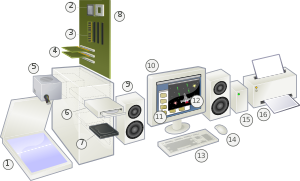
Figurer hardware is a comprehensive term for all physical and tangible parts of a estimator, equally distinguished from the data information technology contains or operates on, and the software that provides instructions for the hardware to achieve tasks. Some sub-systems of a personal computer may contain processors that run a fixed program, or firmware, such as a keyboard controller. Firmware normally is not changed by the terminate user of the personal estimator.
About 2010s-era computers require users only to plug in the power supply, monitor, and other cables. A typical desktop computer consists of a estimator example (or "tower"), a metal chassis that holds the power supply, motherboard, hd, and often an optical disc drive. Most towers have empty space where users can add additional components. External devices such as a figurer monitor or visual display unit, keyboard, and a pointing device (mouse) are usually found in a personal computer.
The motherboard connects all processor, memory and peripheral devices together. The RAM, graphics carte du jour and processor are in most cases mounted straight onto the motherboard. The central processing unit of measurement (microprocessor chip) plugs into a CPU socket, while the ram modules plug into respective ram sockets. Some motherboards have the video display adapter, audio and other peripherals integrated onto the motherboard, while others use expansion slots for graphics cards, network cards, or other I/O devices. The graphics card or sound bill of fare may employ a intermission out box to go on the analog parts away from the electromagnetic radiations within the computer case. Disk drives, which provide mass storage, are connected to the motherboard with one cable, and to the power supply through another cable. Usually, disk drives are mounted in the same instance as the motherboard; expansion chassis are besides made for additional disk storage.
For big amounts of information, a record drive can be used or extra difficult disks can be put together in an external case. The keyboard and the mouse are external devices plugged into the computer through connectors on an I/O panel on the back of the computer case. The monitor is too continued to the input/output (I/O) panel, either through an onboard port on the motherboard, or a port on the graphics card. Capabilities of the personal computer's hardware can sometimes be extended past the addition of expansion cards connected via an expansion bus. Standard peripheral buses often used for adding expansion cards in personal computers include PCI, PCI Limited (PCIe), and AGP (a high-speed PCI passenger vehicle dedicated to graphics adapters, found in older computers). Most modern personal computers have multiple physical PCI Express expansion slots, with some having PCI slots every bit well.
A peripheral is "a device connected to a computer to provide communication (such as input and output) or auxiliary functions (such as boosted storage)".[50] Peripherals generally connect to the computer through the use of USB ports or inputs located on the I/O panel. USB flash drives provide portable storage using wink memory which allows users to access the files stored on the drive on any computer. Memory cards also provide portable storage for users, ordinarily used on other electronics such equally mobile phones and digital cameras, the information stored on these cards tin exist accessed using a memory carte du jour reader to transfer information betwixt devices. Webcams, which are either built into figurer hardware or connected via USB are video cameras that records video in real fourth dimension to either exist saved to the computer or streamed somewhere else over the internet. Game controllers can exist plugged in via USB and can be used as an input device for video games as an alternative to using keyboard and mouse. Headphones and speakers can be connected via USB or through an auxiliary port (found on I/O panel) and permit users to listen to sound accessed on their reckoner; however, speakers may also require an boosted power source to operate. Microphones can be connected through an audio input port on the I/O console and allow the computer to catechumen sound into an electrical signal to be used or transmitted past the estimator.
Software [edit]

Computer software is any kind of computer program, procedure, or documentation that performs some task on a estimator system.[51] The term includes application software such equally word processors that perform productive tasks for users, organisation software such as operating systems that interface with computer hardware to provide the necessary services for application software, and middleware that controls and co-ordinates distributed systems.
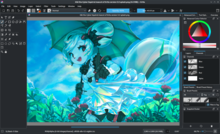
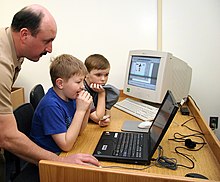
Software applications are common for word processing, Internet browsing, Internet faxing, e-postal service and other digital messaging, multimedia playback, playing of figurer game, and computer programming. The user may have significant noesis of the operating surround and application programs, but is not necessarily interested in programming nor fifty-fifty able to write programs for the computer. Therefore, most software written primarily for personal computers tends to be designed with simplicity of use, or "user-friendliness" in mind. Even so, the software manufacture continuously provide a wide range of new products for use in personal computers, targeted at both the expert and the non-expert user.
Operating system [edit]
An operating system (Bone) manages computer resources and provides programmers with an interface used to access those resource. An operating system processes system data and user input, and responds by allocating and managing tasks and internal organization resources as a service to users and programs of the system. An operating organization performs basic tasks such equally controlling and allocating memory, prioritizing system requests, controlling input and output devices, facilitating computer networking, and managing files.
Common contemporary desktop operating systems are Microsoft Windows, macOS, Linux, Solaris and FreeBSD. Windows, macOS, and Linux all have server and personal variants. With the exception of Microsoft Windows, the designs of each of them were inspired by or directly inherited from the Unix operating system.
Early personal computers used operating systems that supported command line interaction, using an alphanumeric display and keyboard. The user had to call back a large range of commands to, for instance, open a file for editing or to move text from ane identify to another. Starting in the early 1960s, the advantages of a graphical user interface began to be explored, merely widespread adoption required lower-cost graphical display equipment. By 1984, mass-market place estimator systems using graphical user interfaces were bachelor; past the turn of the 21st century, text-mode operating systems were no longer a significant fraction of the personal figurer market.[52]
Applications [edit]
Generally, a reckoner user uses application software to carry out a specific task.[53] System software supports applications[53] and provides common services such as memory management, network connectivity and device drivers, all of which may be used by applications but are not directly of involvement to the end user. A simplified analogy in the world of hardware would be the relationship of an electric light bulb (an application) to an electric power generation establish (a system):[54] the ability plant only generates electricity, not itself of any real use until harnessed to an application like the electric light that performs a service that benefits the user.
Typical examples of software applications are word processors, spreadsheets, and media players. Multiple applications bundled together as a package are sometimes referred to as an application suite. Microsoft Function and LibreOffice,[55] which parcel together a discussion processor, a spreadsheet, and several other detached applications, are typical examples.[56] The separate applications in a suite unremarkably have a user interface that has some commonality making information technology easier for the user to learn and use each application. Often, they may have some adequacy to collaborate with each other in means beneficial to the user; for example, a spreadsheet might be able to be embedded in a word processor document even though it had been created in the separate spreadsheet application.
Stop-user evolution tailors systems to meet the user's specific needs. User-written software include spreadsheet templates, word processor macros, scientific simulations, graphics and animation scripts; even email filters are a kind of user software. Users create this software themselves and often overlook how important it is.
Gaming [edit]
PC gaming is pop among the high-end PC marketplace. According to an April 2018 market analysis done past Newzoo, PC gaming has fallen backside both console and mobile gaming in terms of market share sitting at a 24% share of the entire marketplace. The market place for PC gaming nonetheless continues to grow and is expected to generate $32.3 billion in revenue in the twelvemonth 2021.[57] PC gaming is at the forefront of competitive gaming, known every bit esports, with games such as Overwatch and Counter-Strike: Global Offensive leading the manufacture that is suspected to surpass a trillion dollars in revenue in 2019.[58]
Sales [edit]
[edit]


Personal computers worldwide in million distinguished by developed and developing globe
In 2001, 125 million personal computers were shipped in comparison to 48,000 in 1977.[59] More than than 500 million personal computers were in use in 2002 and one billion personal computers had been sold worldwide from the mid-1970s up to this time. Of the latter figure, 75% were professional or work related, while the rest were sold for personal or home utilise. About 81.5% of personal computers shipped had been desktop computers, 16.four% laptops and 2.ane% servers. The Usa had received 38.viii% (394 million) of the computers shipped, Europe 25% and eleven.7% had gone to the Asia-Pacific region, the fastest-growing market as of 2002. The second billion was expected to be sold by 2008.[60] Almost half of all households in Western Europe had a personal figurer and a estimator could be found in 40% of homes in Britain, compared with only 13% in 1985.[61]
The global personal figurer shipments were 350.9 1000000 units in 2010,[62] 308.3 million units in 2009[63] and 302.2 meg units in 2008.[64] [65] The shipments were 264 1000000 units in the year 2007, according to iSuppli,[66] up 11.2% from 239 million in 2006.[67] In 2004, the global shipments were 183 1000000 units, an 11.6% increase over 2003.[68] In 2003, 152.6 one thousand thousand computers were shipped, at an estimated value of $175 billion.[69] In 2002, 136.7 million PCs were shipped, at an estimated value of $175 billion.[69] In 2000, 140.ii meg personal computers were shipped, at an estimated value of $226 billion.[69] Worldwide shipments of personal computers surpassed the 100-million marker in 1999, growing to 113.5 million units from 93.three million units in 1998.[70] In 1999, Asia had 14.ane million units shipped.[71]
Every bit of June 2008, the number of personal computers in utilise worldwide hit one billion,[72] while another billion is expected to exist reached past 2014. Mature markets like the U.s.a., Western Europe and Japan accounted for 58% of the worldwide installed PCs. The emerging markets were expected to double their installed PCs by 2012 and to take 70% of the 2nd billion PCs. About 180 million computers (16% of the existing installed base) were expected to be replaced and 35 million to be dumped into landfill in 2008. The whole installed base grew 12% annually.[73] [74]
Based on International Data Corporation (IDC) data for Q2 2011, for the first time China surpassed United states in PC shipments by 18.five million and 17.7 million respectively. This tendency reflects the rising of emerging markets as well every bit the relative stagnation of mature regions.
In the developed world, there has been a vendor tradition to keep adding functions to maintain high prices of personal computers. However, since the introduction of the One Laptop per Child foundation and its low-cost XO-1 laptop, the computing manufacture started to pursue the toll too. Although introduced just ane year earlier, at that place were 14 million netbooks sold in 2008.[75] Besides the regular computer manufacturers, companies making especially rugged versions of computers take sprung up, offering alternatives for people operating their machines in extreme weather or environments.[76]
In 2011, Deloitte consulting firm predicted that, smartphones and tablet computers equally computing devices would surpass the PCs sales[77] (every bit has happened since 2012). As of 2013, worldwide sales of PCs had begun to fall as many consumers moved to tablets and smartphones. Sales of xc.three meg units in the 4th quarter of 2012 represented a four.9% pass up from sales in the 4th quarter of 2011.[78] Global PC sales roughshod sharply in the commencement quarter of 2013, according to IDC data. The 14% year-over-year reject was the largest on record since the business firm began tracking in 1994, and double what analysts had been expecting.[79] [lxxx] The decline of Q2 2013 PC shipments marked the 5th straight quarter of falling sales.[81] "This is horrific news for PCs," remarked an analyst. "It'due south all nigh mobile computing at present. Nosotros have definitely reached the tipping point."[79] Information from Gartner showed a similar reject for the same time period.[79] Communist china's Lenovo Group bucked the general tendency as stiff sales to beginning-fourth dimension buyers in the developing world allowed the company's sales to stay flat overall.[79] Windows 8, which was designed to expect similar to tablet/smartphone software, was cited as a contributing factor in the decline of new PC sales. "Unfortunately, it seems clear that the Windows 8 launch not only didn't provide a positive boost to the PC market place, simply appears to have slowed the market place," said IDC Vice President Bob O'Donnell.[80]
In August 2013, Credit Suisse published research findings that attributed effectually 75% of the operating profit share of the PC industry to Microsoft (operating system) and Intel (semiconductors).[82] According to IDC, in 2013 PC shipments dropped by 9.8% as the greatest drop-ever in line with consumers trends to use mobile devices.[83]
In the 2d quarter of 2018, PC sales grew for the first time since the beginning quarter of 2012. According to inquiry house Gartner, the growth mainly came from the business concern marketplace while the consumer marketplace experienced decline.[84]
Average selling price [edit]
Selling prices of personal computers steadily declined due to lower costs of product and manufacture, while the capabilities of computers increased. In 1975, an Altair kit sold for around only United states$400, simply required customers to solder components into excursion boards; peripherals required to interact with the arrangement in alphanumeric form instead of blinking lights would add another $two,000, and the resultant organisation was of use but to hobbyists.[85]
At their introduction in 1981, the US$ane,795 price of the Osborne 1 and its competitor Kaypro was considered an attractive toll indicate; these systems had text-only displays and only floppy disks for storage. By 1982, Michael Dell observed that a personal calculator system selling at retail for about $3,000 Usa was made of components that price the dealer well-nigh $600; typical gross margin on a figurer unit was effectually $1,000.[86] The total value of personal computer purchases in the Usa in 1983 was well-nigh $4 billion, comparable to total sales of pet food. By late 1998, the average selling price of personal reckoner systems in the United States had dropped below $1,000.[87]
For Microsoft Windows systems, the average selling cost (ASP) showed a decline in 2008/2009, possibly due to low-toll netbooks, drawing $569 for desktop computers and $689 for laptops at U.South. retail in August 2008. In 2009, ASP had further fallen to $533 for desktops and to $602 for notebooks past January and to $540 and $560 in February.[88] According to enquiry firm NPD, the average selling toll of all Windows portable PCs has fallen from $659 in Oct 2008 to $519 in October 2009.[89]
Ecology bear upon [edit]
External costs of ecology touch on are not fully included in the selling cost of personal computers.[90]
Personal computers have become a large contributor to the 50 meg tons of discarded electronic waste material generated annually, according to the Un Environs Program. To address the electronic waste issue affecting developing countries and the environment, extended producer responsibility (EPR) acts have been implemented in various countries and states.[91] In the absenteeism of comprehensive national legislation or regulation on the export and import of electronic waste, the Silicon Valley Toxics Coalition and BAN (Basel Action Network) teamed up with electronic recyclers in the US and Canada to create an e-steward programme for the orderly disposal of electronic waste. Some organizations oppose EPR regulation, and claim that manufacturers naturally movement toward reduced cloth and energy use.
Come across likewise [edit]
- List of home computers
- Public computer
- Portable computer
- Desktop replacement reckoner
- Tranquillity PC
- Pocket PC
- Market share of personal computer vendors
- Personal Computer Museum
- Enthusiast computer
References [edit]
- ^ "personal figurer". Dictionary.com Unabridged. Dictionary.com. Retrieved 2018-06-11 .
- ^ Conlon, Tom (29 Jan 2010), The iPad'southward Closed System: Sometimes I Hate Existence Right, Popular Scientific discipline, retrieved 2010-10-14 ,
The iPad is non a personal computer in the sense that nosotros currently understand.
- ^ "Overview of update channels for Role 365 ProPlus". Microsoft. 2018.
- ^ The Encyclopedia of Human-Computer Interaction, 2nd Ed. End-User Evolution. Interaction Design Foundation. 2017.
- ^ "Mac* vs. PC Debate". intel.com. Intel. Retrieved 5 October 2014.
- ^ Finnie, Scot (viii June 2007). "Mac vs. PC cost analysis: How does it all add up?". Computerworld. Computerworld, Inc. Retrieved 5 October 2014.
- ^ Ackerman, Dan (22 August 2013). "Don't buy a new PC or Mac before y'all read this". CNET. CBS Interactive. Retrieved v October 2014.
- ^ Haslam, Karen (11 December 2013). "Mac or PC? Ten reasons why Macs are better than PCs". Macworld. IDG. Retrieved 5 October 2014.
- ^ Rather, Dan (2015-01-23). "1995 video shows the struggle was existent for first-fourth dimension PC users". CBS News.
- ^ "Tutorial Guide to the EDSAC Simulator" (PDF). The EDSAC Replica Project.
- ^ Gene Carter, Wow! What a Ride!: A Quick Trip Through Early Semiconductor and Personal Computer Development, Lulu Press – 2016, affiliate 8
- ^ "1959: Practical Monolithic Integrated Circuit Concept Patented | The Silicon Engine | Figurer History Museum". www.computerhistory.org.
- ^ "1960: Metal Oxide Semiconductor (MOS) Transistor Demonstrated | The Silicon Engine | Computer History Museum". world wide web.computerhistory.org.
- ^ "1964: Get-go Commercial MOS IC Introduced | The Silicon Engine | Figurer History Museum". www.computerhistory.org.
- ^ "1968: Silicon Gate Technology Adult for ICs | The Silicon Engine | Computer History Museum". world wide web.computerhistory.org.
- ^ "1971: Microprocessor Integrates CPU Function onto a Single Scrap | The Silicon Engine | Estimator History Museum". www.computerhistory.org.
- ^ Weidendorfer, Josef (2011). Encyclopedia of Parallel Calculating, Intel Core Microarchitecture, x86 Processor Family unit. Boston, MA: Springer. ISBN978-0-387-09765-7.
- ^ "Forgotten PC history: The truthful origins of the personal computer". 22 August 2008. Archived from the original on 22 August 2008. Retrieved 9 January 2017.
- ^ a b c "IBM Athenaeum". Archived from the original on 10 February 2003. Retrieved 9 January 2017.
- ^ PC Magazine, Vol. 2, No. half-dozen, November 1983, ''SCAMP: The Missing Link in the PC's Past?''
- ^ Roy A. Allan, A Bibliography of the Personal Computer [electronic resource]: the Books and Periodical Articles, Allan Publishing – 2006, p. 73
- ^ Jim Battle (August 9, 2008). "The Wang 2200". Wang2200.org. Jim Battle. Retrieved November 13, 2013.
- ^ Roy A. Allan, A Bibliography of the Personal Computer [electronic resources] : the Books and Journal Manufactures, Allan Publishing – 2006, p. eighty
- ^ The New York Times Guide to Essential Knowledge, Second Edition: A Desk Reference for the Curious Mind (2007). Macmillan, p. 448.
- ^ Green, Wayne (February 1976). "Believe Me – I'thousand No Expert!". 73 Mag. No. 184. Peterborough, NH: 73, Inc. p. 89. Wayne Green visited MITS in Baronial 1975 and interviewed Ed Roberts. Article has several paragraphs on the pattern of the Altair 8800.
- ^ Garland, Harry (March 1977). "Design Innovations in Personal Computers". Estimator. 10 (iii): 24. doi:ten.1109/c-m.1977.217669. S2CID 32243439.
At that place is lilliputian question that the current enthusiasm in personal computing was catalyzed by the introduction of the MITS Altair computer kit in January 1975.
- ^ Dorf, Richard C., ed. The technology handbook. CRC Press, 2004.
- ^ Ceruzzi, Paul E. (2003). A History of Modern Computing. Cambridge, MA: MIT Press. p. 226. ISBN978-0-262-53203-7. "This announcement [Altair 8800] ranks with IBM'due south announcement of the System/360 a decade earlier as ane of the well-nigh significant in the history of computing."
- ^ Freiberger, Paul; Swaine, Michael (2000). Fire in the Valley: The Making of the Personal Reckoner. New York: McGraw-Loma. ISBN978-0-07-135892-vii.
- ^ What's New (February 1978), "Commodore Ships First PET Computers", BYTE, 3 (2): 190 Commodore press release. "The PET calculator fabricated its debut recently as the first 100 units were shipped to waiting customers in mid-October 1977."
- ^ "Apple 2 History". Apple II History. 2008-11-04. Retrieved May 8, 2014.
- ^ "Joe's Heathkit Computer Catalog Page". www.classiccmp.org . Retrieved 2019-03-07 .
- ^ "Heathkit H8". vintagecomputer.com . Retrieved 2019-03-04 .
- ^ "Heathkit H89 computer". oldcomputers.cyberspace . Retrieved 2019-03-04 .
- ^ "Sinclair Research website". Archived from the original on 2014-12-14. Retrieved 2014-08-06 .
- ^ Reimer, Jeremy (November 2, 2009). "Personal Figurer Market Share: 1975–2004". Archived from the original on June 6, 2012. Retrieved 2009-07-17 .
- ^ Reimer, Jeremy (December ii, 2012). "Personal Computer Marketplace Share: 1975–2004". Retrieved 2013-02-09 .
- ^ "Computing Japan". Computing Japan. 54–59: 18. 1999. Retrieved February 6, 2012.
...its venerable PC 9800 series, which has sold more xviii million units over the years, and is the reason why NEC has been the number one PC vendor in Japan for as long equally anyone tin can remember.
- ^ Polsson, Ken. "Chronology of Amiga Computers". Archived from the original on 2 April 2014. Retrieved 9 May 2014.
- ^ "A Decade of Personal Computing". Information Week. 5 Baronial 1991. p. 24.
- ^ Angler, Martin. "Obituary: The PC is Dead". JACKED IN. Archived from the original on Feb 23, 2014. Retrieved Feb 12, 2014.
- ^ Ralston, Anthony; Reilly, Edwin (1993). "Workstation". Encyclopedia of Computer Scientific discipline (Third ed.). New York: Van Nostrand Reinhold. ISBN978-0-442-27679-9.
- ^ Houghton, Andy. "Evolution of Custom Gaming PCs: What Really Fabricated the Difference". digitalstorm.com . Retrieved 28 September 2015.
- ^ Scott Mueller, Upgrading and Repairing Laptops, Que Publishing, 2004, ISBN 0789728001, pp. 18–21
- ^ Desktop notebooks stake their merits [ permanent expressionless link ] , accessed October 19, 2007
- ^ Bott, Ed. "The PC was supposed to die a decade ago. Instead, this happened". ZDNet.
- ^ Erica Ogg (August 20, 2009). "Fourth dimension to drib the Netbook label". CNN.
- ^ "Light and Inexpensive, Netbooks Are Poised to Reshape PC Industry", The New York Times, April 1, 2009, retrieved 2010-ten-14 ,
AT&T announced on Tuesday that customers in Atlanta could get a type of compact PC called a netbook for just 50 The states$ if they signed up for an Internet service program... 'The era of a perfect Internet computer for 99 US$ is coming this year,' said Jen-Hsun Huang, the chief executive of Nvidia, a maker of PC graphics chips that is trying to adapt to the new technological order.
- ^ New Windows Mobile 6 Devices :: Jun/Jul 2007 Archived March four, 2008, at the Wayback Motorcar
- ^ "Definition of PERIPHERAL". world wide web.merriam-webster.com . Retrieved 2019-03-05 .
- ^ "Wordreference.com: WordNet 2.0". Princeton University, Princeton, NJ. Retrieved 2007-08-nineteen .
- ^ "GUI Definition". www.linfo.org . Retrieved 2019-02-22 .
- ^ a b Weik, Martin (2000). Computer science and Communications Dictionary. Boston, MA: Springer. ISBN978-0-7923-8425-0.
- ^ "Awarding software". ScienceDaily. Archived from the original on 2015-04-30.
- ^ Kinser, Jason (2015). Kinematic Labs with Mobile Devices. Kinematic Labs with Mobile Devices. Morgan and Claypool. Bibcode:2015klmd.book.....Thousand. doi:10.1088/978-1-6270-5628-ane. ISBN978-ane-6270-5627-4.
- ^ Garrison, Bruce (1999). "Microsoft Office 2000 software suite". World Communication: 105 – via Ebscohost.
- ^ "Global Games Marketplace Revenues 2018 | Per Region & Segment". Newzoo . Retrieved 2019-04-25 .
- ^ "Newzoo: Global esports market will exceed $ane billion in 2019". GamesIndustry.biz . Retrieved 2019-04-25 .
- ^ Kanellos, Michael. "PCs: More than 1 billion served". CNET News. Retrieved Baronial 9, 2001.
- ^ Kanellos, Michael (June 30, 2002). "personal computers: More than 1 billion served". CNET News. Retrieved 2010-10-14 .
- ^ "Computers reach i billion marker". BBC News. July 1, 2002. Retrieved 2010-10-14 .
- ^ Global PC shipments grew xiii.8 percent in 2010 – Gartner study, January xiii, 2011, retrieved at September 12, 2011
- ^ Laptop Sales Soaring Amongst Wider PC Growth: Gartner, May 27, 2010, Andy Patrizio, earthweb.com, retrieved at September 12, 2011
- ^ Worldwide PC Shipments in 2008, March 16, 2009, ZDNet, retrieved at September 12, 2011
- ^ PC Sales Up for 2008, but Barely, Jan 14, 2009, Andy Patrizio, internetnews.com, retrieved at September 12, 2011
- ^ ISuppli Raises 2007 Computer Sales Forecast, pcworld.com, 2007-06-19, retrieved January xiii, 2009
- ^ iSuppli raises 2007 reckoner sales forecast, Macworld Great britain, retrieved January xiii, 2009
- ^ Global PC Sales Leveling Off, newsfactor.com, archived from the original on June 14, 2011, retrieved January thirteen, 2009
- ^ a b c HP dorsum on top of PC marketplace , retrieved Jan xiii, 2009
- ^ Yates, Nona (January 24, 2000). "Dell Passes Compaq every bit Tiptop PC Seller in U.Southward". Los Angeles Times . Retrieved January xiii, 2009.
- ^ Economic recovery bumps AP 1999 PC shipments to record high, zdnetasia.com, retrieved January xiii, 2009 [ expressionless link ]
- ^ "Worldwide PC use to reach 1 billion by 2008: report". CBC News. Retrieved June 12, 2007.
- ^ "Gartner Says More than 1 Billion PCs in Use Worldwide and Headed to two Billion Units past 2014" (Press release). Gartner. June 23, 2008. Archived from the original on December four, 2008. Retrieved 2010-10-14 .
- ^ Tarmo Virki (June 23, 2008). "Computers in use pass i billion mark: Gartner". Reuters. Retrieved 2010-10-14 .
- ^ "4P Computing – Negroponte'due south 14 One thousand thousand Laptop Impact". OLPC News. December xi, 2008. Retrieved 2010-10-14 .
- ^ Conrad H. Blickenstorfer. "Rugged PC leaders". Ruggedpcreview.com. Retrieved 2010-10-xiv .
- ^ Tablets, smartphones to outsell PCs https://news.yahoo.com/south/afp/20110210/tc_afp/itinternettelecomequipmentmobileconsumerproduct
- ^ "Gartner Says Declining Worldwide PC Shipments in Quaternary Quarter of 2012 Bespeak Structural Shift of PC Market". Gartner.Com (Press release). January 14, 2013. Archived from the original on Jan 15, 2013. Retrieved Jan 18, 2013.
- ^ a b c d "Feeble PC manufacture stumbles to steep sales drop during 1st quarter as Windows makeover flops". Washington Times. Associated Press. Apr ten, 2013. Archived from the original on April 19, 2013. Retrieved April eleven, 2013.
- ^ a b Nick Wingfield (April ten, 2013). "PC Sales Still in a Slump, Despite New Offerings". The New York Times . Retrieved April 11, 2013.
- ^ "Steve Ballmer'due south retirement leaves Microsoft in a replacement crisis". August 24, 2013.
- ^ "The Apple Vs. Samsung Title Fight for Mobile Supremacy". The Financialist. Credit Suisse. August 8, 2013. Archived from the original on August 14, 2013. Retrieved August xiii, 2013.
- ^ John Fingas (March iv, 2014). "PC shipments faced their steepest-ever drop in 2013".
- ^ Warren, Tom (xiii July 2018). "PC sales are growing for the commencement fourth dimension in six years". The Verge . Retrieved 14 July 2018.
- ^ Marvin B. Sussman Personal Computers and the Family Routledge, 1985 ISBN 0-86656-361-10, p. 90.
- ^ Kateri M. Drexler Icons of business: an encyclopedia of mavericks, movers, and shakers, Volume 1, Greenwood Publishing Group, 2007, ISBN 0-313-33863-ix, p. 102
- ^ Nancy Weil, Average PC Toll drops below $one thousand, PC World December 1998. Retrieved November 17, 2010. Archived October 11, 2011, at the Wayback Car
- ^ Joe Wilcox (April 16, 2009). "Netbooks Are Destroying the Laptop Market and Microsoft Needs to Act Now". eWeek. Retrieved 2010-10-14 . [ permanent dead link ]
- ^ Shane O'Neill (December ii, 2009). "Falling PC Prices Pit Microsoft Against PC Makers". Retrieved 2010-10-14 .
- ^ Mattison, Richard (2012-10-03). "The true cost of personal computers". GreenBiz. GreenBiz Group Inc. Retrieved 28 September 2016.
- ^ Nash, Jennifer; Bosso, Christopher (2013). "Extended Producer Responsibleness in the The states: Full Speed Ahead?" (PDF). Journal of Industrial Ecology. 17 (ii – RPP–2013–04): 175–185. doi:10.1111/j.1530-9290.2012.00572.x. S2CID 154297251. Retrieved August 23, 2014.
Further reading [edit]
- Accidental Empires: How the boys of Silicon Valley brand their millions, battle foreign competition, and withal can't get a date, Robert 10. Cringely, Addison-Wesley Publishing, (1992), ISBN 0-201-57032-7
- PC Magazine, Vol. 2, No. 6, November 1983, ''SCAMP: The Missing Link in the PC's By?''
External links [edit]
- How Stuff Works pages:
- Dissecting a PC
- How PCs Work
- How to Upgrade Your Figurer
- How to Build a Computer
- Global archive with product information-sheets of PCs and Workstations
Source: https://en.wikipedia.org/wiki/Personal_computer

Post a Comment for "Number of Families Who Own Pcs Between 1990 and 2000"